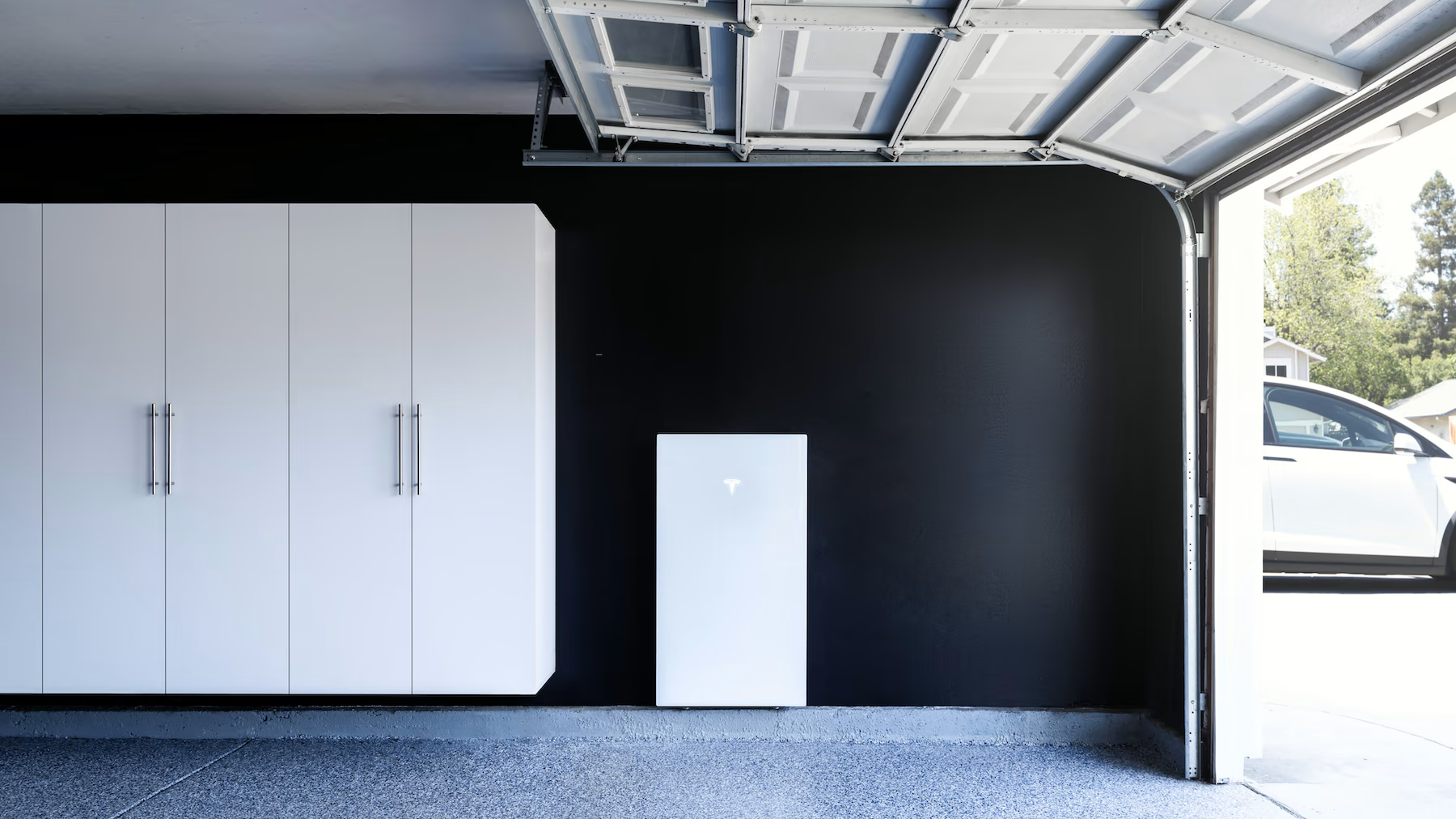
Making EV Charging Easier at Home
For many electric vehicle owners, home charging quickly becomes the most convenient way to keep their car powered.
In fact, the Australian Government says around 80% of reported EV charging in Australia takes place at home.
But while you can charge an EV from a standard household power point, a dedicated EV charger can provide faster charging and give you greater control over when your vehicle uses electricity.
And if your home has solar, you can potentially use your own solar generation to help charge your EV.
Can You Charge an EV From a Normal Power Point?
Yes.
A standard 240V power point provides what is commonly referred to as Level 1 charging, with a maximum charging rate of around 2.4kW.
For drivers with relatively short daily trips, this may be enough. The Australian Government estimates the average Australian drives around 33 km per day, meaning some EV owners may be able to meet their everyday driving needs simply by charging overnight.
However, charging from a standard power point is considerably slower than using a dedicated EV charger.
What Is a Dedicated EV Charger?
A dedicated home charger is generally a Level 2 AC charger, connected directly to your home’s electrical supply.
Home EV chargers typically operate between 7kW and 22kW, allowing substantially faster charging than a standard power point. Depending on the charger and vehicle, the Australian Government says a dedicated home charger can typically charge an EV three to ten times faster than a standard power point.
The important thing to remember is that the charger isn’t the only factor determining charging speed.
Your EV also has a maximum AC charging rate, so installing a 22kW charger doesn’t necessarily mean your vehicle will charge at 22kW.
Your home’s electrical supply and installation also need to be considered.
Do You Actually Need a Dedicated Charger?
Not necessarily.
A standard power point may be perfectly suitable if you:
- Drive relatively short distances each day
- Usually park at home overnight
- Don’t need to recharge quickly
- Have access to a suitable power point
A dedicated charger may make more sense if you drive longer distances, have multiple EVs, want faster charging or want greater control over when your vehicle charges.
A licensed electrician can assess your home’s electrical setup and help determine the appropriate option.
Can You Charge Your EV Using Solar?
Absolutely — and this is where EV charging can become particularly interesting for households with solar.
Instead of sending excess solar energy to the grid, you can potentially use some of that generation to charge your vehicle.
For example:
Solar panels → Home → EV charger → Electric vehicle
Charging during the day when your solar system is generating can reduce the amount of electricity your EV needs to draw from the grid.
The Australian Government specifically recommends considering rooftop solar when planning EV charging, as charging while solar is being generated can help reduce charging costs.
What Is Smart EV Charging?
Smart charging takes things a step further.
A smart EV charger can use information about your electricity tariff, energy consumption or solar generation to control when your vehicle charges.
For example, you could configure a compatible system to prioritise charging when your rooftop solar is producing excess energy or when electricity prices are lower.
This can help your EV become part of your home’s wider energy management system rather than simply another appliance drawing power whenever it is plugged in.
What If You Have Solar and a Battery?
If your home already has solar and battery storage, an EV charger can be incorporated into the overall energy system.
Depending on the equipment and system design, your home could use solar generation for household appliances, charge your battery with surplus energy and direct available energy towards your EV.
The right setup will depend on your home’s energy consumption, solar generation, battery capacity and the charging requirements of your vehicle.
Zeneco Energy offers EV charging solutions ranging from basic home charging through to solar-linked systems, designed around the vehicle, home and energy requirements.
What EV Charger Do You Need?
There isn’t one charger that’s right for every EV owner.
Before choosing a system, it’s worth considering:
- Your vehicle’s maximum AC charging rate
- How many kilometres you drive each day
- How long your vehicle is normally parked at home
- Your home’s electrical supply
- Your existing solar system
- Whether you want solar or smart charging
- Whether you may have more than one EV in the future
The charger should be matched to both your vehicle and your home’s electrical infrastructure.
What About the Plug?
For AC charging in Australia, Type 2 is the standard plug type used by most public AC chargers, although the exact charging connection for your vehicle should always be checked with the manufacturer.
For faster DC charging, CCS2 is the standard connector used in Australia.
Home charging is generally AC rather than the high-powered DC charging you’ll find at dedicated fast-charging stations.
Is a Home EV Charger Worth It?
For some EV owners, a standard power point may be all they need.
For others, a dedicated charger can make charging significantly quicker and more convenient — particularly when combined with smart charging or rooftop solar.
The key is choosing a system based on how you actually drive and use energy at home, rather than simply choosing the highest-powered charger available.
Ready to Charge Smarter?
Whether you’re purchasing your first EV or already driving electric, the right charging setup can make everyday charging much easier.
Zeneco Energy can help you explore EV charging options for your home, including solutions that can work alongside your existing or new solar system.
We’ll look at your vehicle, energy use and electrical setup to help determine what makes sense for your home.
Get in touch with Zeneco Energy to discuss your EV charging options.
Call us on 0405 338 660 or visit www.zenecoenergy.com.au to book a no-obligation consultation. We’ll run the numbers for your home, confirm your eligibility, and handle the process alongside you.
Information current as of October 2026
EV charging technology, vehicle specifications, electricity tariffs and government programs can change over time. Charger selection and installation should be assessed by a licensed electrician and matched to the requirements of the specific EV.
Sources
Australian Government – How to charge your electric vehicle
Australian Government – Electric vehicle charging equipment
Australian Government – Charging options for houses and strata buildings